
Training as a team
Jst-4-Fn already provides the references, calls and first maneuvers needed to fly together. This page does not introduce a second standard. It gathers methods to prepare, rehearse and improve a team flight.
A useful session is not necessarily a full run-through of the choreography. It is often more effective to choose one movement or transition, make the problem visible, and rehearse it with a precise goal.
Prepare a movement before flying
Section titled "Prepare a movement before flying"Describe the maneuver step by step
Section titled "Describe the maneuver step by step"A team can break a sequence into several frames, on paper or in a digital tool. Each frame should show an important position rather than every instant of the movement.
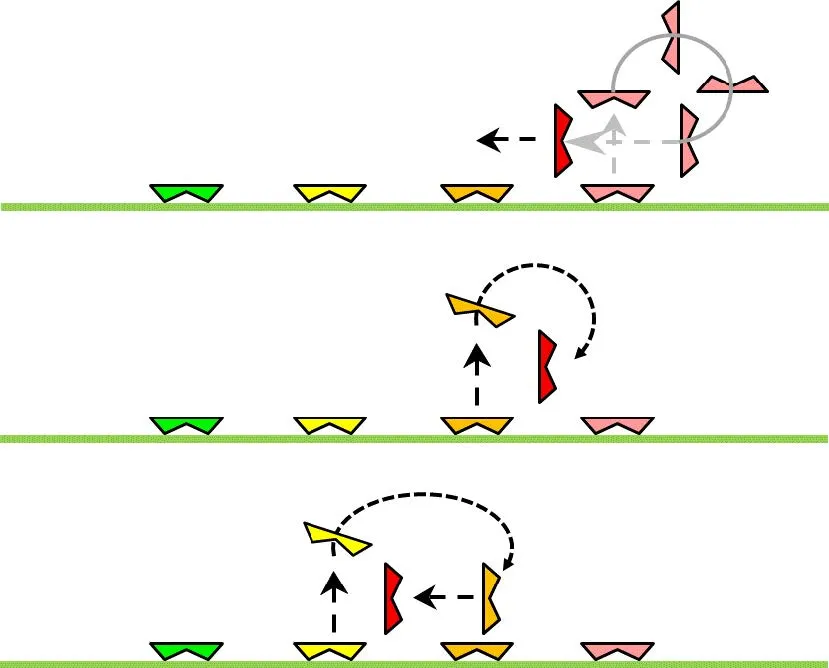
To keep the drawing readable:
- use a different color for each kite;
- show the initial and final positions;
- represent movement with arrows;
- note the kite order when needed;
- add calls and, for a ballet, useful musical cues.
The goal is not to produce a polished document. It is to help every pilot understand what to watch, wait for and execute.
Simulate with sticks
Section titled "Simulate with sticks"Each teammate represents their kite with a stick: a rod or spar with a small kite shape made from cardboard, laminated paper or a 3D print.
This method lets the team rehearse positions, orientations and timing without depending on the wind. A filmed simulation can also support individual practice.
A spare rod, a cardboard cut-out and some tape are enough to get started.
Simulate with magnets and string
Section titled "Simulate with magnets and string"Magnets moved on a board can show a formation from the front. When they are connected with string, they can also represent flying lines and line wraps.
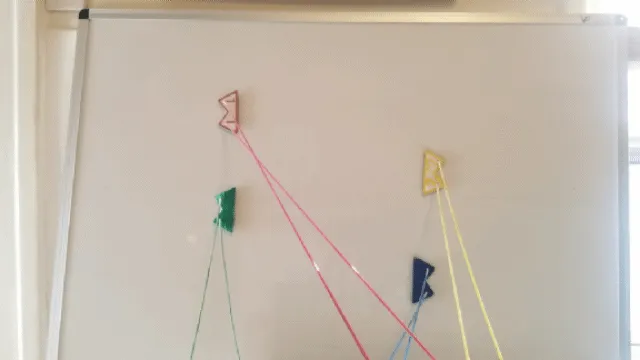
This is particularly useful when a sequence looks simple in the sky but leaves different pilots with different line turns. A series of pictures taken from a fixed camera can also become an animated GIF.
Remember a choreography together
Section titled "Remember a choreography together"Walk or dance the sequence
Section titled "Walk or dance the sequence"Pilots can take the place of their kites and walk through the choreography themselves. The movement immediately reveals crossings, pauses and changes of direction.
This does not replace flying. It helps the team build a shared representation before putting the kites back in the air.
Use a simulator
Section titled "Use a simulator"A few teams reproduce their choreography in 2D on a computer. The result can be very clear, but producing it takes time and suitable tools remain uncommon.
See these Jst-4-Fn simulation examples.
Move from the model to the field
Section titled "Move from the model to the field"A simple training loop is often enough:
- choose a short sequence and an observable goal;
- agree on the calls, positions and turns;
- rehearse at a comfortable pace;
- film the flight when that helps the debrief;
- correct one problem at a time, then repeat.
Individual practice still matters: the more hovering, reverse flight, side slides and speed control become automatic, the more attention each pilot can give to the group.
Additional resources
Section titled "Additional resources"- Aerialis Kites: Thoughts on team flying and Team flying feedback
- KiteLife: When it becomes routine, Team basics and Al Hargus’s Team Handbook
- AKA: Choreography in pairs and Flying in pairs
Continue
Section titled "Continue"Last updated