
Joining a megateam
A megateam, often called a mega-fly in the United States, brings many pilots together around one leader, shared calls and a precise use of space. It is not the best setting in which to discover team-flying basics. Start with the Jst-4-Fn basic maneuvers, then become familiar with the vocabulary used by the group.
On QuadKites.org, we mostly use megateam for the international practice and Mega-Fly when referring to the historical North American vocabulary or Mike Kory’s manual. This page gathers the references specific to large teams, especially grid flying.
Before joining the line
Section titled "Before joining the line"In a megateam, every pilot needs to give much of their attention to the leader, their position and the neighboring kites. Before launch:
- identify your place in the formation, both on the pilot line and on the kite side, as well as your immediate neighbors;
- ask which calls the group already knows and whether any special figures or conventions will be used;
- ask for an explanation when the grid or a transition is unclear;
- follow the announced pace and avoid improvising to recover from a mistake.
The group may use the Jst-4-Fn basics and then add vocabulary from the North American maneuvers. What matters is that every pilot gives the next call the same meaning.
Understand grid flying
Section titled "Understand grid flying"In a grid, each kite occupies one cell within a larger formation. The wind window is no longer considered for a single pilot: it is shared between several lines, rows and groups.
Thierry Deschamps introduces this organization on his French-language KiteJust4Fun blog:
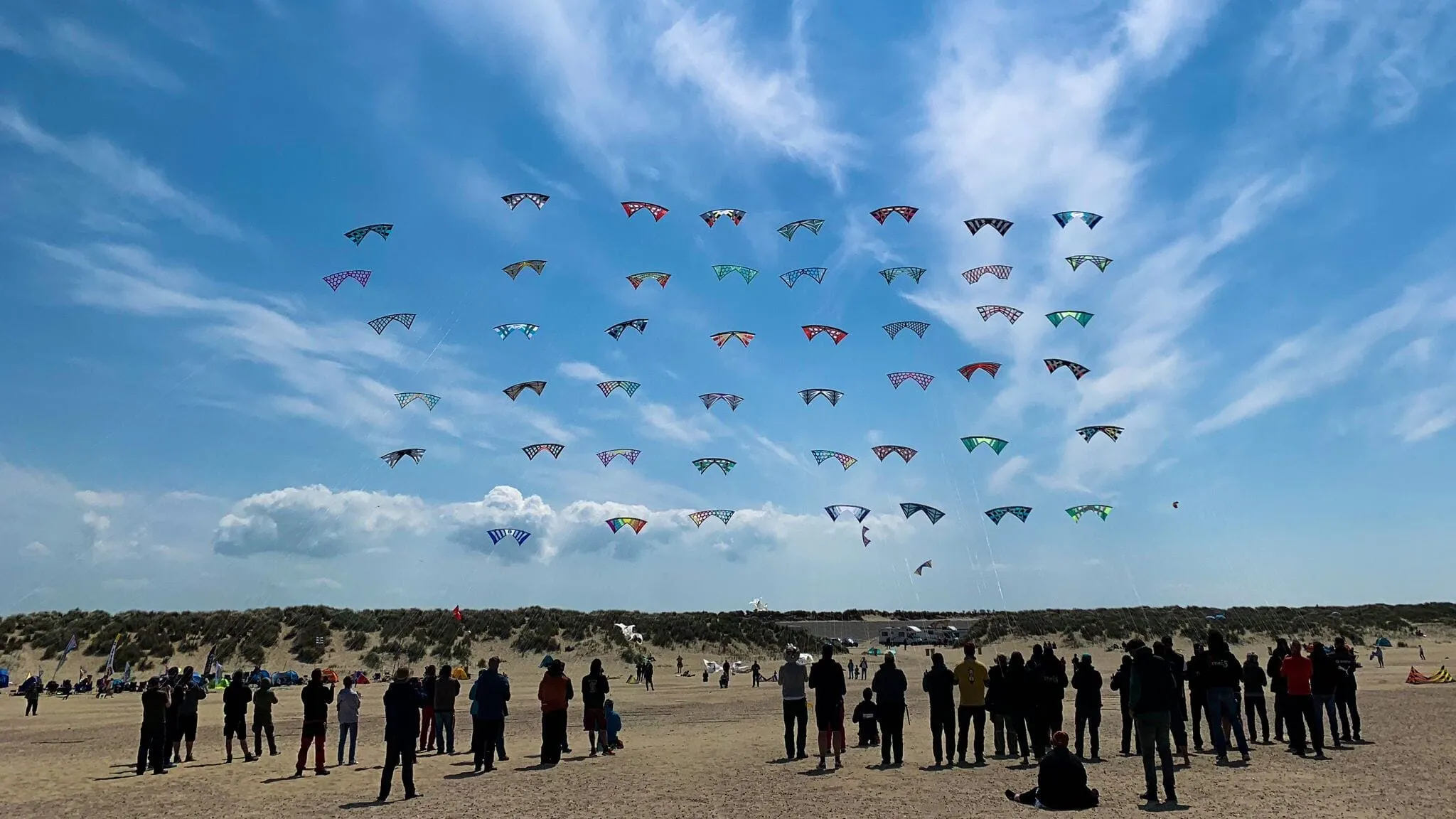
On May 16, 2026, on Brouwersdam beach in the Netherlands, 118 quad-line kites flew together: this is the current documented world record for a quad-line megateam. A local report announced the record after the 10th International Quadline Meeting in Brouwersdam.
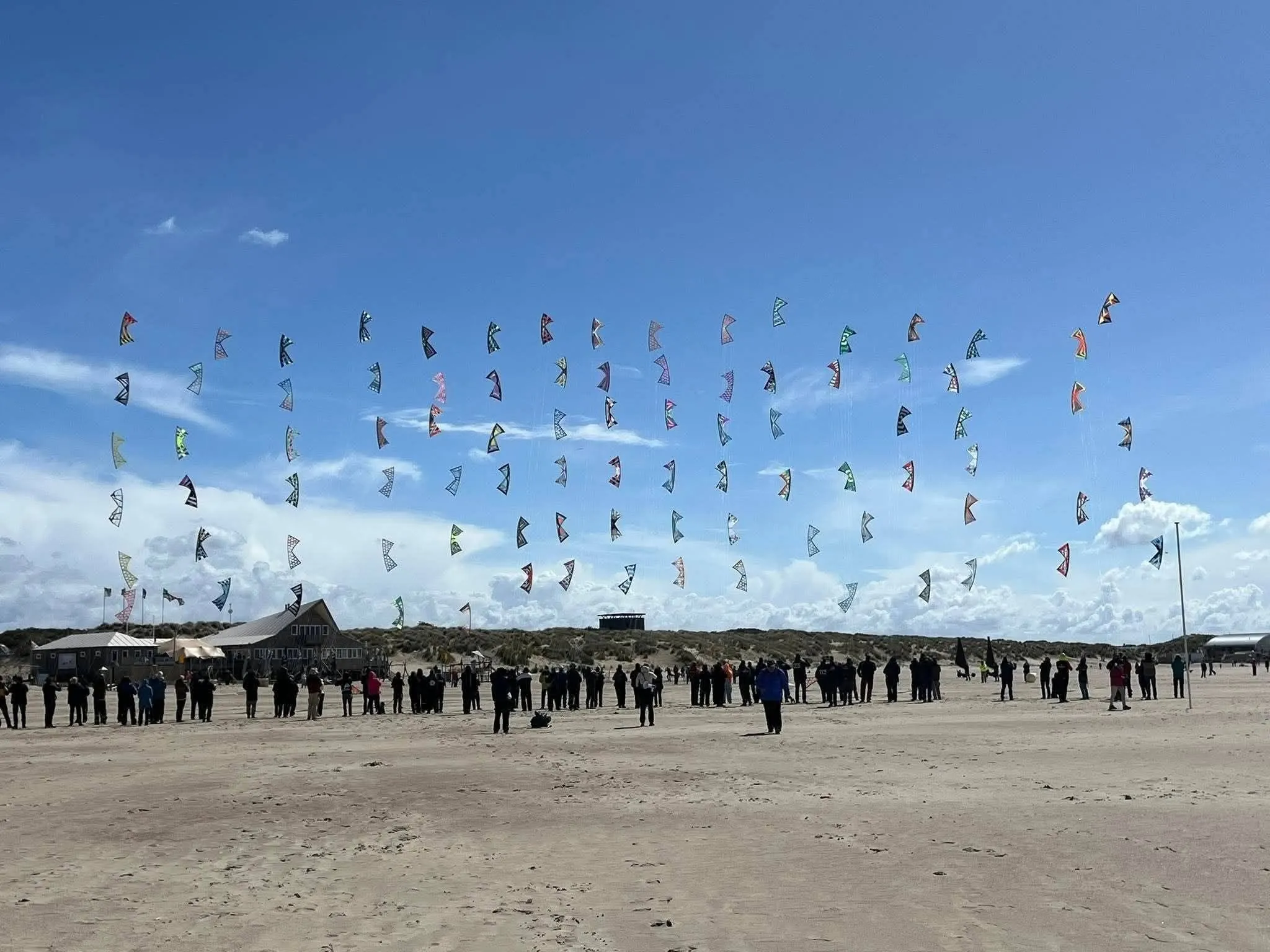
Grid flying is one of the usual formats for a megateam. What becomes rare is going beyond roughly 20 to 25 kites: at that scale, organization, readability and spacing change significantly. These two videos show an extreme case, with a megateam of about 90 pilots: the first version is uncut, with the briefing and live instructions; the second is a shorter version, without briefing, where the maneuvers are easier to observe.
Recognize a few formations
Section titled "Recognize a few formations"These resources show several figures used in large grids:
The Mega-Fly manual by Mike Kory is also a historical reference for international vocabulary and formations.
Watch a complete megateam
Section titled "Watch a complete megateam"When watching a video, do not only follow the overall shape. Also observe:
- the delay between the call and the movement;
- how rows maintain their spacing;
- the transitions between formations;
- how the group slows down or settles before a difficult sequence.
Communication and organization
Section titled "Communication and organization"In a very large team, the leader’s voice must remain understandable to everyone. Some groups use PMR radios to relay calls: using radios in a megateam.
For a participant’s perspective, also read What to expect in a mega fly on KiteLife.
Last updated